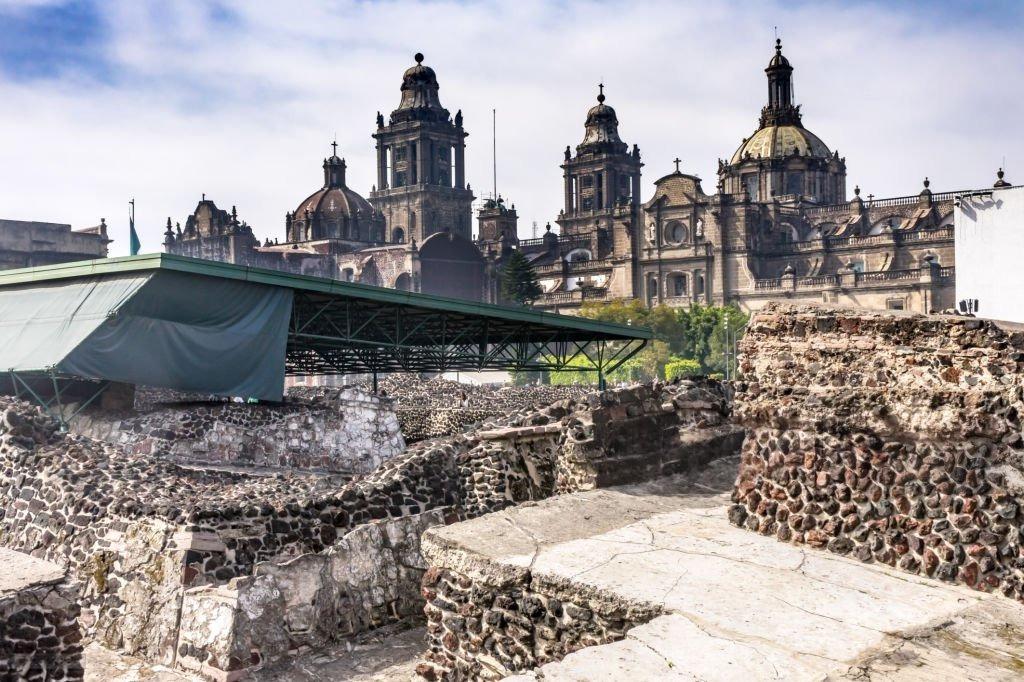
If you’re exploring Mexico City’s Historic Center, you’ll likely pass very close to the Templo Mayor. Nestled among buildings, streets, and plazas is an archaeological site that preserves part of what was once Tenochtitlan, the ancient Mexica city.
The visit combines the open-air ruins with a museum filled with artifacts discovered during the excavations. Before you go, we’ll tell you how much admission costs, what you can see, and how much time you should set aside for your visit.
What was the Templo Mayor, and what will you find there today?
The Templo Mayor was the most important religious center in Tenochtitlan and was dedicated to two deities: Tláloc, associated with rain and agriculture, and Huitzilopochtli, associated with war.
The temple wasn’t built all at once; the Mexica expanded it over the years, and it went through seven construction phases. The final version reached a height of about 45 meters and stood on a base measuring about 400 meters on each side.
What You’ll Find as You Explore the Ruins
Not everything you’ll see is part of the main temple, as the site preserves various structures, sculptures, and spaces that help you imagine what this place was like centuries ago.
The Different Stages of the Temple
One of the most interesting things is that you can still see remnants of the temple’s various expansions.
During the tour, you’ll find:
- Stairways from different periods.
- Snake heads.
- Altars and sculptures.
- Remnants of paint.
- Elements associated with Tláloc and Huitzilopochtli.
The fourth phase is one of the most easily recognizable because it preserves part of the double staircase that led to the two shrines.
Tláloc and Huitzilopochtli
The temple had two sides: the north was dedicated to Tláloc and the south to Huitzilopochtli.
The difference between these two spaces helps us better understand the role these deities played for the Mexicas. Tláloc was associated with water, rain, and harvests, while Huitzilopochtli had a strong connection to war and the religious traditions of Tenochtitlan.
The Tzompantli and the House of the Eagles
The Tzompantli is one of the most striking sites. It was a structure associated with rituals and sacrifices and was decorated with depictions of skulls.
There is also the House of the Eagles, a space where ceremonies were held. Its ruins are part of the tour of the archaeological site.
Templo Mayor Museum: What to See After the Ruins
After walking through the ruins, head inside the museum. It’s a great way to round out your visit because there you can see many of the artifacts discovered during the excavations.
Among the items you’ll find are:
- The Coyolxauhqui monolith.
- Artifacts related to Tláloc and Huitzilopochtli.
- Offerings and items used in rituals.
- Mexica sculptures.
- Depictions of animals and plants.
- Artifacts recovered from different parts of the site.
The museum opened its doors in 1987, and admission is included with your ticket to the archaeological site.
What to Visit Near the Templo Mayor
One of the advantages of visiting the **Templo Mayor** is that you’re right in the heart of the Historic Center. You don’t need to take any other form of transportation to explore several nearby sites.
You can continue walking to:
- Zócalo: It’s right next to the archaeological site.
- Metropolitan Cathedral: across from the Plaza de la Constitución.
- National Palace: known for its murals by Diego Rivera.
- Streets of the Historic Center: here you’ll find restaurants, shops, plazas, and historic buildings.
If you want to make the most of your day, you can visit the Templo Mayor in the morning and then head to the Zócalo and the other sites in the Historic Center.
Templo Mayor: Price, Hours, and How to Get There
Here’s what you should check before heading out:
Hours and Tickets
The site is open Tuesday through Sunday from 9:00 AM to 5:00 PM. On Sundays, admission is free for Mexicans, and there are other cases of free admission established by the INAH.
- Domestic visitors: $105 MXN
- Foreign visitors: $210 MXN
- Children under 13: Free
How to Get There
Getting to the Templo Mayor is quite easy because it’s located right in the heart of the Historic Center, just a few steps from the Zócalo. If you’re taking the metro, the closest station is Zócalo on Line 2. From there, you can walk to the entrance of the archaeological site.
Remember: Smoking, eating, bringing pets, and using flash photography are not permitted inside the site.
Where to Stay in Mexico City?
If you’re planning to visit the Templo Mayor and other sites in the Historic Center, choosing a well-located place to stay can make exploring the city much easier.
At Wynwood House, you’ll find fully furnished apartments in Mexico City, complete with a fully equipped kitchen and private spaces to relax after exploring the Templo Mayor, the Zócalo, and other nearby attractions.
Book your stay and enjoy Mexico City with a comfortable place to rest between each outing.
FQs
How much does it cost to enter the Templo Mayor?
In 2026, admission costs 105 MXN for domestic visitors and 210 MXN for foreign visitors. Mexicans can enter for free on Sundays, as well as in other cases specified by the INAH.
How much time do you need to visit the Templo Mayor?
Allow about two hours to explore the ruins and visit the museum at a leisurely pace. If you want to stop and read about or examine the artifacts at a more leisurely pace, you can stay longer.
What is there to see at the Templo Mayor?
You can explore the remains from the temple’s different periods, see sculptures, altars, the Tzompantli, and the House of the Eagles. The visit also includes the Templo Mayor Museum, where artifacts found during the excavations are on display.