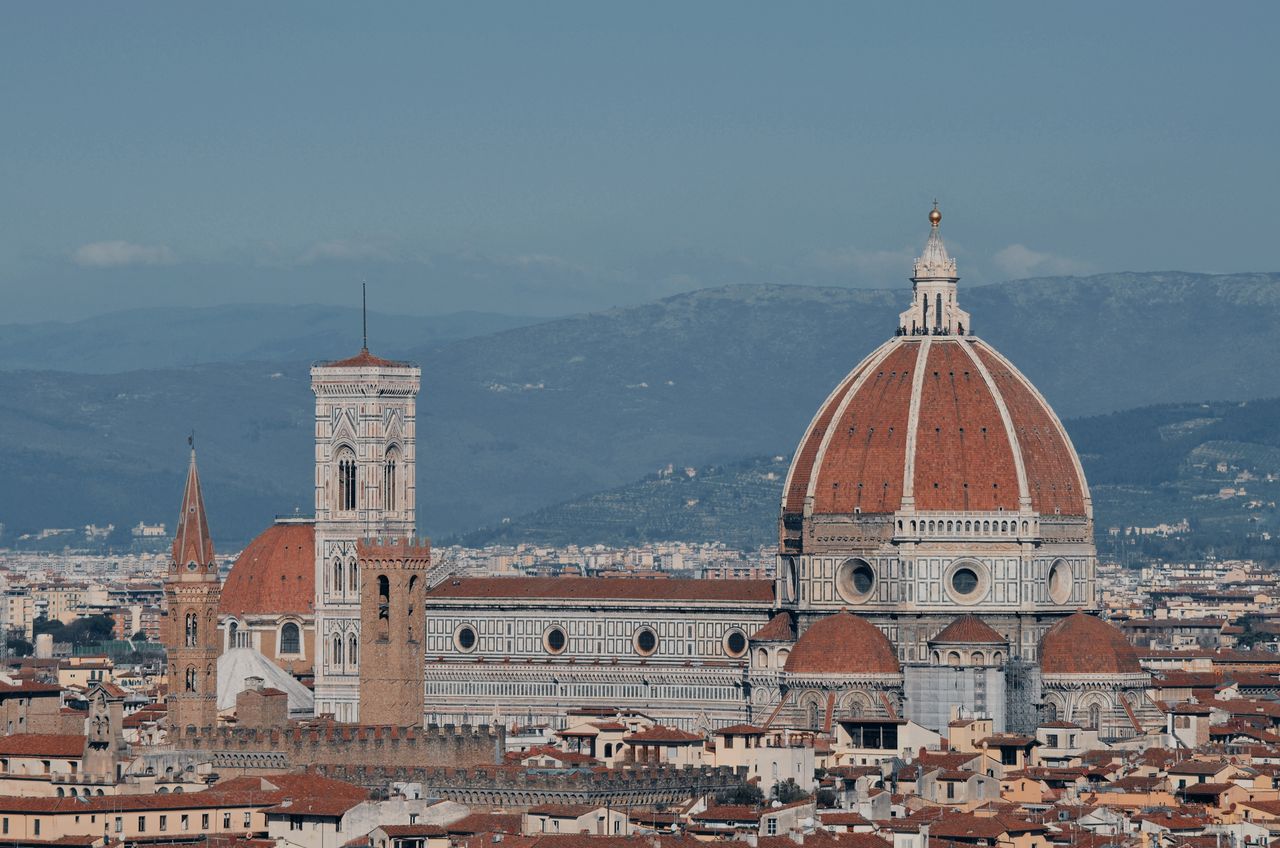
The Florence Duomo, officially the Cathedral of Santa Maria del Fiore, is one of the largest churches in the world and the defining landmark of Florence’s skyline. Its red-tiled dome, designed by Filippo Brunelleschi, has watched over the city for nearly six centuries and remains one of the most visited sites in Italy.
The History of the Florence Duomo
Construction began on September 8, 1296, under architect Arnolfo di Cambio, whose original plan was smaller than today’s building. After his death, the project stalled before Giotto took over in 1334, focusing on the bell tower that still bears his name. Following Giotto’s death in 1337, Andrea Pisano and Francesco Talenti continued the work, expanding the cathedral and completing the main structure by 1359.
By the mid-14th century, Florentine architecture shifted away from Gothic toward more classical influences, and the exterior was covered in white marble from Carrara, green from Prato, and red from Siena. Goldsmith Lorenzo Ghiberti and sculptor Filippo Brunelleschi later finished the project. Brunelleschi carved several statues and designed the dome’s innovative engineering, completing the polygonal base by 1421 and the dome itself roughly 15 years later. The cathedral was consecrated upon the dome’s completion by Pope Eugene IV on March 25, 1436.
The facade seen today isn’t original. It was destroyed in the late 16th century and left bare for centuries until architect Emilio De Fabris redesigned it in the 19th century, using the same marble and adding sculptural details from leading Tuscan artists of the period.
Brunelleschi’s Dome: An Engineering Marvel
When completed, Brunelleschi’s dome was the largest in the world, measuring 45 meters in diameter and rising 100 meters above the cathedral floor. Its design solved a problem that had puzzled architects for over a century: how to build a dome of that scale without traditional wooden supports. Brunelleschi’s double-shell structure and herringbone brick pattern became one of the most influential engineering achievements of the Renaissance, and the dome remains the symbol most associated with Florence today.
Inside the Cathedral
Santa Maria del Fiore is built as a triple-nave basilica, with the presbytery nested beneath the dome and three radial apses, each containing five chapels. The cathedral stretches roughly 153 to 160 meters in length and around 90 meters across at the transept, making it one of the largest churches in Christendom. In its time, it could hold up to 30,000 worshippers, and today it ranks among the largest cathedrals in the world, surpassed in size only by a handful of churches such as St. Peter’s Basilica in the Vatican and the cathedrals of Seville and Milan.
Other Landmarks in the Duomo Complex
The Piazza del Duomo brings together several landmarks beyond the cathedral itself. Giotto’s Bell Tower stands 85 meters tall, and visitors willing to climb its 414 steps are rewarded with sweeping views over Florence’s rooftops. Nearby, the Baptistery of San Giovanni predates the cathedral and adds another layer of history to the square. Beneath the cathedral, a small crypt houses the tomb of Brunelleschi himself, discovered in the mid-20th century near the main entrance, a rare honor for an architect of his era.
Nearby Attractions Worth Combining With Your Visit
Florence’s historic center is compact enough to explore almost entirely on foot. A short walk from the Duomo leads to Piazza della Signoria, the city’s traditional seat of civic power and home to Palazzo Vecchio. From there, the Uffizi Gallery is just steps away, holding masterpieces like Botticelli’s “The Birth of Venus,” and is often paired with a Duomo visit. For travelers with extra time, the Accademia Gallery in Florence, home to Michelangelo’s “David,” is another essential stop and one of the city’s most visited museums alongside the Duomo.
Visiting Hours and Admission
Access to the cathedral itself is free, without a ticket, Monday through Saturday from 10:15 a.m. to 3:45 p.m. Because it remains an active place of worship, the cathedral closes to visitors on Sundays and during religious celebrations.
Visiting the dome, bell tower, baptistery, and museum requires a separate combined ticket, since these sites are managed together as the Duomo complex. Skip-the-line combinations are available that pair entry with an audio guide to the city, and several guided tour options exist for travelers who want deeper context, including tours that combine the dome climb with the bell tower or the museum.
Tips for Visiting the Florence Duomo
Book dome tickets in advance. Access to Brunelleschi’s dome is limited and tends to sell out, especially during peak travel months, so reserving ahead avoids disappointment.
Dress appropriately. As an active church, the cathedral enforces a modest dress code, so shoulders and knees should be covered.
Combine your visit strategically. Since the Uffizi Gallery and the Accademia Gallery in Florence sit within easy walking distance, many visitors plan the Duomo alongside one of these museums to make the most of a day in the historic center.
Where to Stay Near the Florence Duomo
After a day exploring Santa Maria del Fiore and the surrounding piazza, having a comfortable base nearby makes it easy to return for an evening view of the dome lit up against the sky. Travelers looking for the luxury places to stay in Firenze or the best places to stay in Firenze will find that Wynwood House offers centrally located apartments within walking distance of the Duomo, the Uffizi, and Florence’s other major landmarks.
Frequently Asked Questions
Is it free to visit the Florence Duomo?
Yes, entry to the cathedral itself is free, without a ticket, from Monday to Saturday between 10:15 a.m. and 3:45 p.m. Climbing the dome or bell tower, or visiting the museum and baptistery, requires a separate paid ticket.
How long does it take to climb Brunelleschi’s dome?
The climb involves 463 steps and typically takes visitors 30 to 45 minutes round trip, depending on crowds. Tickets are timed and limited, so booking in advance is strongly recommended.
What other sites should I visit near the Florence Duomo?
The Uffizi Gallery and the Accademia Gallery in Florence are both within walking distance and pair well with a Duomo visit. Giotto’s Bell Tower and the Baptistery of San Giovanni, both part of the same piazza, are also worth including in the same day.