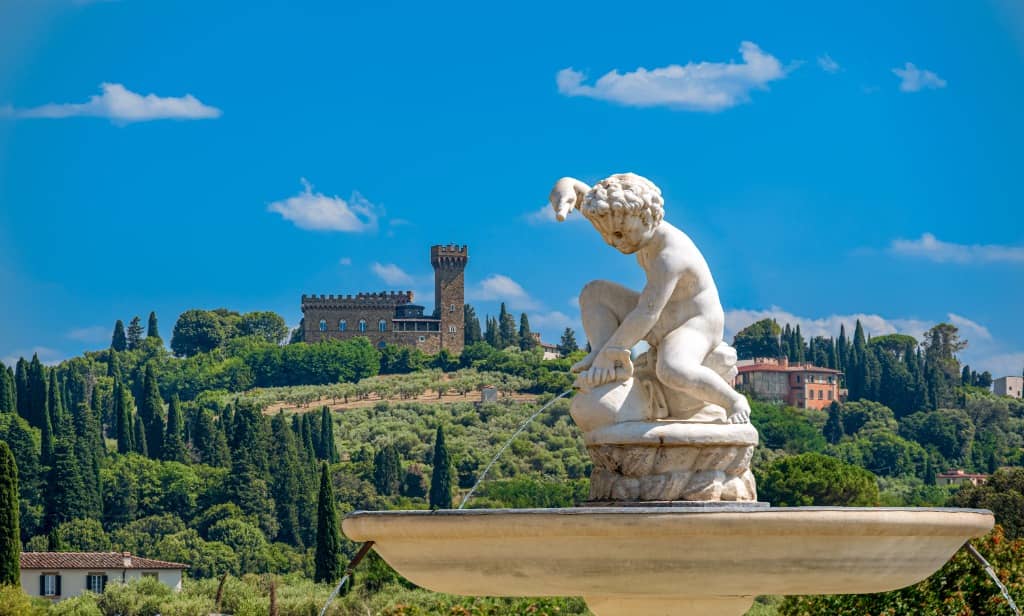
The Boboli Gardens are Florence’s most beloved green escape, a hillside Renaissance garden behind the Palazzo Pitti in the Oltrarno district. Beyond the shade and the statues, they offer some of the best views of the city, with the Duomo and the Palazzo Vecchio rising in the distance.
The History of the Boboli Gardens
The gardens date to the 16th century. After the Medici family bought the Palazzo Pitti in 1549, they commissioned a monumental garden that reflected their power and wealth. It was originally the private garden of the palace where the family lived, and almost 500 years later it has lost none of its charm.
Today the gardens receive around a million visitors a year, though they remain a favorite with Florentines too, who come to read on the lawns or simply walk. In 2013, UNESCO added the Medici villas and gardens of Tuscany to the World Heritage List, recognizing their importance.
What to See in the Boboli Gardens
The terrain is hilly, so exploring can be tiring, but each corner rewards the effort. These are the highlights worth prioritizing:
- The Amphitheater: near the main entrance, surrounded by ancient Roman statues and a granite obelisk brought from Luxor, Egypt.
- Fountain of Neptune: set on a hill with lovely views over the gardens.
- Statue of Abundance: a large sculpture by Giambologna and his pupil Pietro Tacca, high in the gardens.
- Giardino del Cavaliere: a quiet raised terrace with floral displays, wonderful views, and a porcelain museum.
- Viale dei Cipressi: a long avenue lined with cypresses and statues leading toward the Isolotto.
- Limonaia: a 17th-century lemon house built to shelter citrus plants through winter.
- Kaffeehaus: a rococo pavilion designed for sipping coffee with a panoramic view.
- Buontalenti Grotto: an artificial cave with stucco figures and frescoes, containing a copy of Michelangelo’s “Prisoners.”
Tickets and Prices
Prices depend on the ticket type:
- Single ticket: 10 euros, which also includes the Villa Bardini gardens.
- Combined Boboli and Palazzo Pitti: 22 euros.
- Five-day PassePartout: 38 euros in high season (about December 21 to January 9 and February 21 to November 9) or 18 euros in low season, also covering the Palazzo Pitti, the Uffizi, and the Opificio delle Pietre Dure.
Visitors aged 18 to 25 pay 2 euros, and anyone under 18 enters free. Booking on the official website adds a 3-euro reservation fee per ticket but saves you the line at the box office, which can be long in high season.
You can visit on your own, but a guided tour helps explain the fountains, sculptures, and design of the gardens. Guided visits run around 45 euros, while a Palazzo Pitti and Boboli ticket with an audio guide costs about 39 euros. Guided tours also use timed entry, so they help you skip the line.
Opening Hours
The gardens open daily from 8:15 a.m., with closing time depending on the season: 7:10 p.m. in June, July, and August; 6:30 p.m. in April, May, and September; 5:30 p.m. in March and October; and 4:30 p.m. from November to February. They close on December 25 and on the first and last Monday of each month.
How Long to Spend and When to Go
Plan about an hour and a half for the main sights, or up to three hours if you want to relax on the lawns and enjoy the views. Arrive at 8:15 a.m. to beat the tour groups. April, May, September, and October offer the best weather, while summer can be sweltering, so bring water.
Photos are allowed, but drones, bicycles, scooters, and pets are not.
How to Get to the Boboli Gardens
The gardens belong to the Palazzo Pitti at Piazza de’ Pitti 1, on the south bank of the Arno about 300 meters from the Ponte Vecchio. You can enter through the palace or via the Annalena entrance on Via Romana, the Forte di Belvedere, or Porta Romana. Walking is the best option, and buses C3 and C4 stop near the palace.
Pairing Boboli With the Accademia Gallery in Florence
Many visitors combine the gardens with the Accademia Gallery in Florence, home to Michelangelo’s original David. It sits at Via Ricasoli 58/60, just a few minutes from the Duomo, and opens Tuesday through Sunday from 8:15 a.m. to 6:50 p.m. A standard ticket costs 20 euros, plus a 4-euro booking fee, with 2 euros for ages 18 to 25. A 48-hour combined ticket with the Bargello costs 26 euros. Reservations are strongly recommended, and most visits take one to two hours.
Tips for Visiting the Boboli Gardens
Take your time. The best advice is to go without rushing and sit for a while to take in the views of Florence. Avoid weekends and holidays if you want fewer crowds, and remember that visiting the gardens takes about two hours, plus roughly three more if you also tour the Palazzo Pitti.
Free admission applies to visitors under 18, people with disabilities, school groups and teachers, tour guides, university students and professors, accredited journalists, and Ministry of Culture staff. If you bring children, note that running, playing ball games, and making noise are not allowed.
Where to Stay in Florence
After a day among the gardens and galleries, a central base makes Florence easy to explore on foot. Travelers looking for the luxury places to stay in Firenze will find that The Collection offers an upscale option, while the best places to stay in Firenze through Wynwood House keep the main sights close.
Frequently Asked Questions
How much does it cost to visit the Boboli Gardens?
A single ticket costs 10 euros, a combined ticket with the Palazzo Pitti costs 22 euros, and visitors under 18 enter free. Booking online adds a 3-euro fee.
How long do you need at the Boboli Gardens?
About an hour and a half covers the main points, while up to three hours lets you rest on the lawns and enjoy the views over Florence.
Can you visit the Accademia Gallery on the same day?
Yes. The Accademia Gallery in Florence is a short trip across the city. Book a timed ticket in advance and plan one to two hours to see Michelangelo’s David.